
IEA Global EV Outlook 2021

The Global EV Outlook is an annual publication that identifies and discusses recent developments in electric mobility across the globe. It is developed with the support of the members of the Electric Vehicles Initiative (EVI).

Combining historical analysis with projections to 2030, the report examines key areas of interest such as electric vehicle (EV) and charging infrastructure deployment, energy use, CO2 emissions and battery demand. The report includes policy recommendations that incorporate learning from frontrunner markets to inform policy makers and stakeholders that consider policy frameworks and market systems for electric vehicle adoption.

This edition also features an update of the electric heavy-duty vehicle models coming onto commercial markets and slotted for release in the coming few years, and on the status of development of megachargers. It compares the electric vehicle supply equipment per EV with the recommended AFID targets. It also analyses the impact of EV uptake on governments’ revenue from fuel taxation. Finally, it makes available for the first time two online tools: the Global EV Data Explorer and Global EV Policy Explorer, which allow users to interactively explore EV statistics and projections, and policy measures worldwide.
RMI India Mobilising Finance for EVs in India: A Toolkit of Solutions to Mitigate Risks and Address Market Barriers

India’s transition to electric vehicles (EVs) has advanced rapidly in the past few years. A supportive policy environment, improving economics, and emerging business models have poised the EV market for significant growth in the coming decade.

Key barriers related to EV adoption—including technology cost, infrastructure availability, and consumer behaviour—must be overcome. Our report Mobilising Finance for EVs in India: A Toolkit of Solutions to Mitigate Risks and Address Market Barriers highlights financing as another key hurdle to accelerating uptake. EV buyers currently face a range of financing challenges, such as high interest and insurance rates, low loan-to-value ratios, and limited specialised financing options. These challenges will only become more important to address as EV adoption picks up.

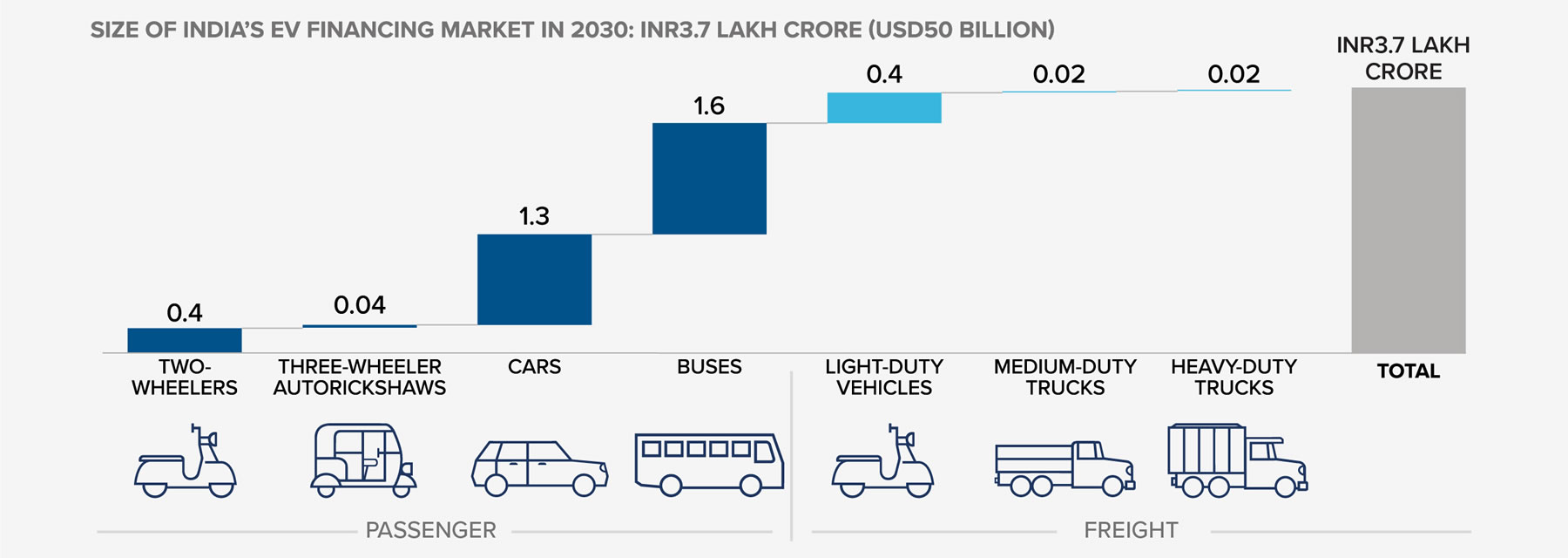
The quantity of capital and finance required for India’s EV future is considerable. Our analysis estimates that the cumulative capital cost of the country’s EV transition between 2020 and 2030 is INR 19.7 lakh crore across vehicles, charging stations, and batteries. The projected size of the annual loan market for EVs in 2030 is INR 3.7 lakh crore.

Considering the future capital and financing requirements for India’s EV transition, it is important to start developing solutions to enable finance for EVs today. NITI Aayog and Rocky Mountain Institute, with RMI India as a research support, have developed a toolkit of 10 solutions for government, industry, and financial institutions.

Carbon Tracker Nothing to lose but your chains: The emerging market transport leapfrog

Click here to download the report from Carbon Tracker.

Falling battery prices and the decarbonisation of transport systems in emerging markets will reduce dependency on oil imports and decimate demand for oil.

Emerging markets are now facing a choice between importing expensive oil at rising prices and growing dependency, or domestic electricity, produced by renewable sources with prices falling over time.

Oil demand is highly problematic for emerging markets
Emerging market oil importers spend 2% of GDP on oil imports. These markets typically have a high and rising dependency on imported oil, and suffer around 285,000 premature deaths a year from pollution linked to transport.

Greening transport gives solutions
The electrification of transport and falling battery prices enable electric vehicles (EV) to compete directly on purchase price with internal combustion engine (ICE) vehicles. In turn, this reduces the cost of energy imports per vehicle by at least 90%, cutting the number of premature deaths from air pollution linked to transport by at least 75%, and lowering the cost to consumers by at least two thirds.

The emerging market transport leapfrog
China is leading the way in electric vehicles. For instance, EV made up 59% of bus sales and 61% of 2-wheeler sales in 2019.

Elsewhere, markets are poised to follow. The Indian government targets 30% of car sales to be EV by 2030 and similarly, early adoption sectors like 2-wheelers are taking off from India to Vietnam.

An emerging market transport leapfrog would reduce expected 2030 demand by over 70% in a Business As Usual scenario. In addition, factor in the war on plastics, and it becomes ever more likely that oil demand has already peaked.

Stay up to date! More information about the Drive Electric Campaign is coming this spring.

The Drive Electric Campaign will use the information you've shared to send you relevant updates and will store, process, and manage your information according to our privacy policy.