
Towards A Sustainable Battery Manufacturing Industry: The Case for Effective Reuse and Recycling
The Compact City Scenario – Electrified
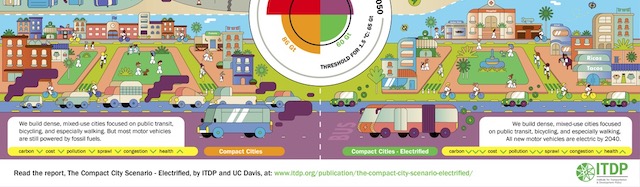
For the urban transportation sector—one slice of the climate-change equation—the road to keeping below 1.5°C global warming involves both compact cities developed for walking, cycling and public transit, as well as a rapid and strategic transition to electrified vehicles.
This report details why these two policy changes, implemented in tandem, are necessary to lower cumulative greenhouse gas emissions from urban passenger transport by 59 gigatonnes (Gt) CO2-eq by 2050. This combination of policy changes would reduce the sector’s emissions by about 50% over the next 30 years, just below the amount needed to limit the impending damage that climate change can bring.
The stakes for workers in how policymakers manage the coming shift to all-electric vehicles

Rapid technological change, new market dynamics, and global action to mitigate climate change is driving a historic shift toward electric vehicles (EVs) in the automotive sector. Although hybrid electric vehicles have been part of the U.S. vehicle fleet for more than two decades, and some mass-market EVs have been available for over a decade, battery electric vehicles (BEVs), which are powered exclusively by a battery and an electric motor, currently make up a small part of U.S. auto sales. And the batteries and other drivetrain components in BEVs are largely made by non-U.S. suppliers. The coming shift toward BEVs is a transformational change to the industry that is by now inevitable.
Given that this shift is coming, the most important question for policymakers is how the shift will be managed. Smart policy can transform this industry upheaval into a new beginning for U.S. producers and the rebuilding of a foundation for good jobs. If instead policy remains on autopilot through the upcoming transformation, the shift will instead reduce U.S. employment and further batter job quality in the auto sector. The policy actions needed to boost job quality and employment in the auto sector in coming years are not radical. Instead, they are commonsense measures like ensuring that any taxpayer subsidies or rebates to incentivize auto purchases come attached with specific requirements on labor standards in the industry, and with measures to boost investment in domestic auto capacity of U.S. producers and suppliers. If policymakers pass such commonsense measures, the U.S. can regain leadership in auto production in coming decades, and the benefits of this leadership will accrue to workers in the industry.
New York Clean Trucks Program: An Analysis of the Impacts of Zero-Emission Medium- and Heavy-Duty Trucks on the Environment, Public Health, Industry, and the Economy
The analysis examines all on-road vehicles registered in New York with greater than 8,501 pounds gross vehicle weight, encompassing vehicle weight classes from Class 2b though Class 8. This is a diverse set of mostly commercial vehicles that includes heavy-duty pickups; school and shuttle buses; sanitation, construction, and other types of work trucks; and freight trucks ranging from local delivery vans to tractor-trailers that weigh up to 80,000 pounds when loaded.
Collectively the New York M/HD fleet includes more than 684,000 vehicles that annually travel more than 11.5 billion miles and consume almost 1.3 billion gallons of petroleum-based fuels. In New York M/HD vehicles are currently responsible for an estimated 15.4 million metric tons (MMT) of greenhouse gas (GHG) emissions annually—approximately 24 percent of all GHGs from the on-road vehicle fleet.1 In New York M/HD vehicles are also responsible for 52 percent of the nitrogen oxide (NOx) and 45 percent of the particulate matter (PM2 ) emitted by on-road vehicles, both of which contribute to poor air quality and resulting negative health impacts in many urban areas, including low-income and disadvantaged communities that are often disproportionately affected by emissions from freight movement due to their proximity to transportation infrastructure.
EDF analysis finds American fleets are embracing electric trucks
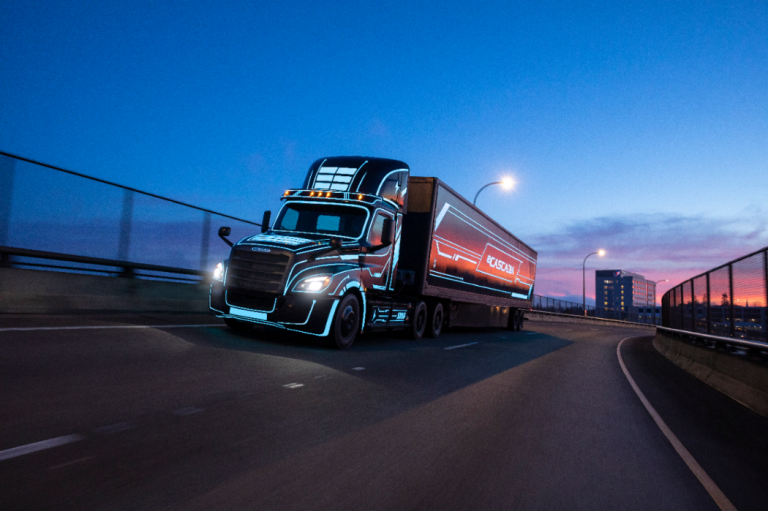
Truck fleets across the country are enthusiastically embracing the emergence of electric medium- and heavy-duty trucks. This is the main finding of a new Environmental Defense Fund (EDF) analysis of public announcements and known deployments of leading fleets. EDF found nearly 500 existing electric deployments and pledges to deploy nearly 300 times more vehicles as additional models become available.
The analysis, which will be updated periodically to reflect new announcements and pledges, is available via a sortable Google Sheet. Click here to read a summary of the fleet commitments.
ITDP Maximizing Micromobility: Unlocking Opportunities to Integrate Micromobility and Public Transportation
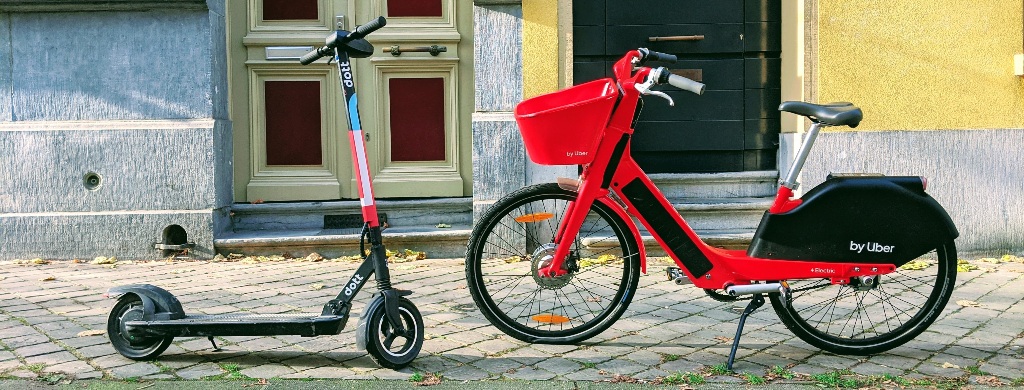
Micromobility is a transportation option that can be used for a variety of trip types, from short commutes, to first- and last-mile connections with transit, to inter-/intra-neighborhood trips. Micromobility refers to small, lightweight devices that:
- Typically operate at speeds below 25 km/h (15 mph)
- Can be human-powered or electric
- Can be shared or personally owned
- Are ideal for trips up to 10 km.
The Maximizing Micromobility report analyzes strategies cities can employ to integrate micromobility and pre-existing public transit systems. By doing so, these cities can build more efficient, affordable, and low-carbon urban landscapes for residents.
SLOCAT Tracking Trends in a Time of Change: The Need for Radical Action Towards Sustainable Transport Decarbonisation

The SLOCAT Transport and Climate Change Global Status Report – 2nd edition tells the global and regional stories of where we are and where we need to get to urgently on climate action in the transport sector. With contributions from more than 150 world-class experts and organisations, it is a one-stop shop for the latest available data, targets and developments on transport demand, emissions, policies and measures – showing that it is imperative to accelerate radical action for sustainable transport and climate in this time of unprecedented global change.
Berkeley Public Policy 2035 Report 2.0: Plummeting Costs & Dramatic Improvements in Batteries Can Accelerate Our Clean Transportation Future

The 2035 Report 2.0 shows that, with the right policy, it is technically and economically feasible for all new car and truck sales to be electric by 2035, saving lives, cutting transportation costs, and creating millions of jobs. This report models the total cost of ownership for gasoline and electric vehicles, finding that electric trucks are already cheaper to own than diesel versions on a total cost-per-mile basis, and finding that electric cars will be cheaper than gasoline equivalents within the next five years. The study also models public charging infrastructure, estimating the number and cost of the public charging ports needed to accommodate tens of millions of electric cars and trucks, the power supplies needed to meet the increased power demand from this shift, and the capital investment needed to achieve an accelerated transition. Combined with a 90 percent clean energy grid, electrifying all new cars and trucks by 2035 would prevent 150,000 premature deaths and avoid $1.3 trillion in environmental and health costs through 2050 by reducing air pollution, especially in frontline communities near major roads, transit centers, or freight hubs. The rapid electrification of new car and truck sales would save consumers $2.7 trillion by 2050, which translates to about $1,000 for every household per year over the next 30 years, and would support a net increase of over 2 million jobs in 2035. But we need smart policy to realize these benefits, including strengthened federal fuel efficiency standards, state zero-emission vehicle standards, and labor standards to encourage the domestic manufacturing and sale of electric cars and trucks.
[1]test
EV100 Progress and Insights Report 2021
Despite a turbulent year, major companies from around the world have doubled down on their commitments and action on electric mobility.
Click to read the Progress and Insights report on how EV100 members are driving the EV revolution.
In just a year, the number of electric vehicles deployed by EV100 members has risen to 169,000, over twice the number from last year. The total number of vehicles committed to be EV by 2030 as part of EV100 commitments has risen by 80% to 4.8 million.
Read the EV100 Progress and Insights Report 2021 for more.